
The explosion of immersive entertainment experiences just might be the hottest industry topic of 2025—look no further than our fall cover story. And in November, right on cue, author and brand marketing veteran Charles Melcher published “The Future of Storytelling: How Immersive Experiences Are Transforming Our World” (Artisan Books).
Over the span of 320 pages, Melcher makes the case that the dawn of the “next media renaissance” is upon us, and how immersive experiences are reshaping culture and business. He argues that storytelling is progressing from flat, passive media into interactive and participatory experiences, or as he calls them, “living stories.” The concept is brought to life with the help of 50-plus real-world examples across interactive art installations, immersive theater, gaming, experiential retail, LARP (Live Action Role Playing) and top-notch brand activations.
The author has plenty of experience to draw from. Melcher is the founder of the Future of Storytelling, an organization that gathers top creatives and technologists IRL for networking, sharing of best practices and collaboration. He also has more than 30 years of experience in brand storytelling with companies including PepsiCo, Microsoft and Netflix, as well as authors like Oprah Winfrey.
Key terms and concepts within the book include how the future of storytelling is agentic (giving attendees the power to make meaningful choices that have consequences within the story), how audiences are transforming into “actiences” (taking on new roles and finding new avenues of self-expression), how AI and other cutting-edge tech is allowing for personalization at scale, and why communal “living stories” can be transformational.
To learn more about the current evolution of immersive storytelling, we sat down with Melcher for a deep dive into the book, and what he has dubbed “a profound paradigm shift from a world where we passively consumed media to where we actively participate in our stories.” Following is an excerpt from our conversation.
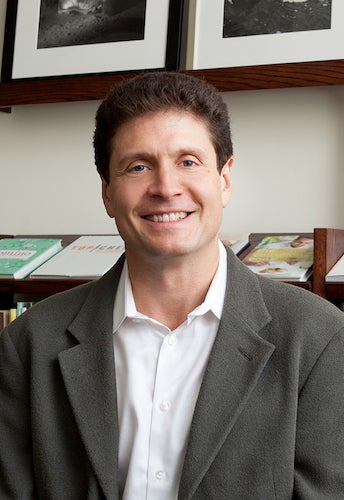
Charles Melcher
Event Marketer: What was the impetus for writing this book?
Charles Melcher: When I started the Future of Storytelling Summit, the job there was to find the mavericks, the innovators, the people who were doing the crazy things in their garage or their lab or their studio, and bring them together to this event so that they could cross-pollinate, collaborate and inspire each other. So literally, we were curating the future. From doing that for so many years, I got to go and experience these extraordinary new forms of storytelling, be they analog or digital, and meet the creators.
Because I had that front-row seat, I started to see certain patterns. We had grown up in an age where all of our media was unidirectional, one-way, it was fixed and linear. But all the things I was getting to do were completely different. They were things where I had a role, where it was immersive, it was embodied, it was participatory. You had real agency and that opportunity to make decisions. And because you had that agency, in some cases, it was really responsive, it was changing and reflecting you… So I realized, we’re not in Kansas anymore, Toto. This is the beginning of a very, very different type of storytelling.
EM: There’s a bit of a paradox in creating a linear piece of media to address this topic.
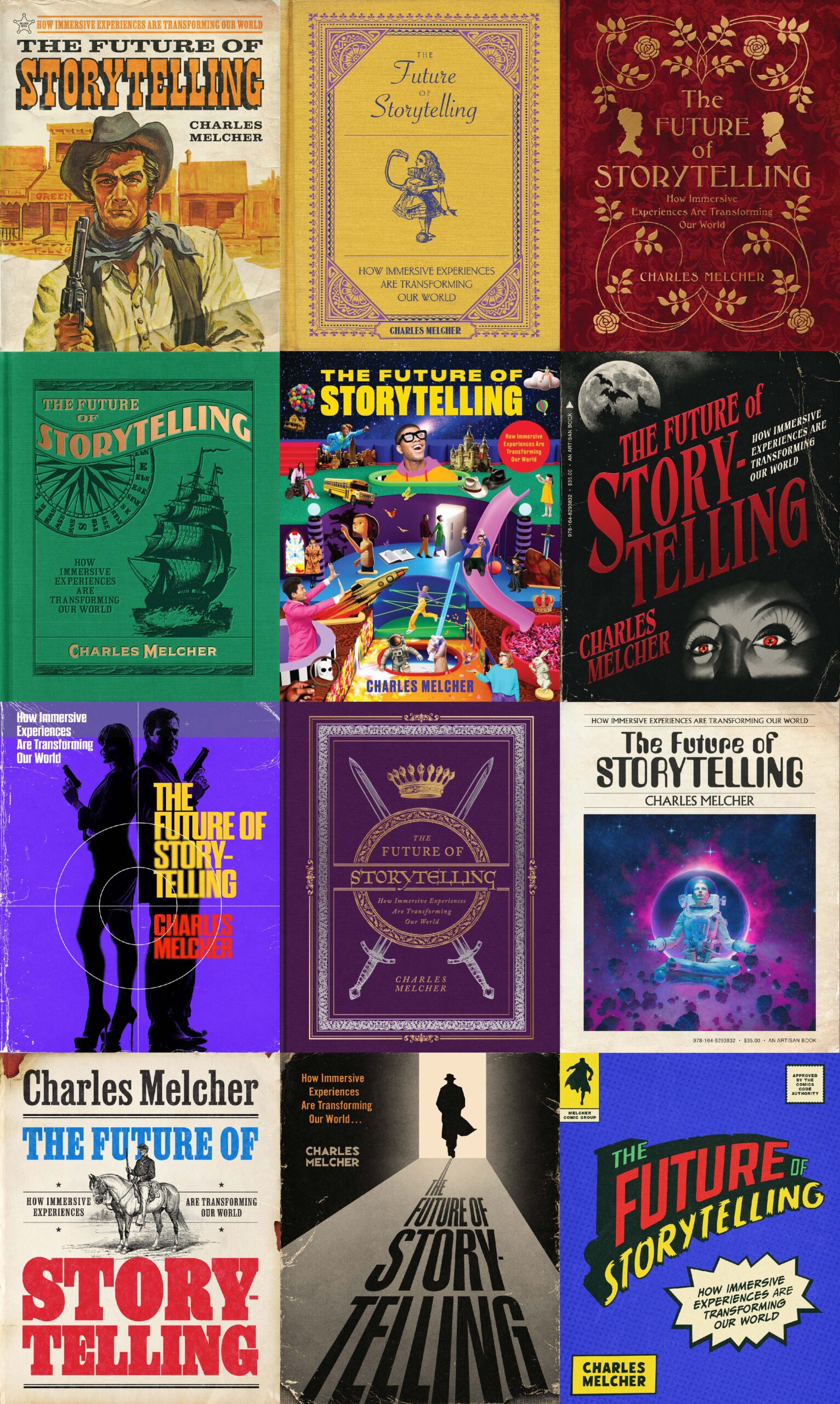
CM: One of the things that that I was thinking a lot about is, in the future of storytelling, all of the participants will get to play roles, right? You’ll get to live your stories, and you’ll get to choose what character you want to inhabit or what story world you want to enter into. And I was trying to think about, how do I embed that idea into the physical form of the book? Plus, in the book, I talk a lot about having agency and personalization, and there’s a little bit of an irony to be talking about all that in a medium that’s linear and flat. So we decided we would do a very special kind of cover. The dust jacket can be unfolded into 12 different covers. Each one represents a different genre of storytelling.
EM: The word ‘immersive’ gets tossed around pretty liberally these days. What’s your definition?
CM: I realized that there are three different ways that people talk about immersion. Sometimes they just mean physical. Like, ‘Oh, look, there’s something all around me. I’m physically immersed in this scene.’ Sometimes they mean that you have the ability to interact in some way.
Another way people talk about immersion, and I think the higher-order one, is this idea of emotional, where you’re not just participating, but your decisions have consequences and emotional resonance, or consequences that have a moral weight to them. And the best living stories are aspiring to do all three of them. They want to physically put you in the world; they want to give you some ability to interact, to have agency in that world, to participate; and the emotional stakes are there—your actions have consequences.
EM: The book talks about how social media democratized storytelling and how that unlocked something primal in the human race. Tell us more.
CM: All of a sudden, everybody could tell stories and make them and distribute them inexpensively. And it turns out everybody wanted to; there was just this explosion of content created by people. And so that shows that we’re not meant to be passive couch potatoes.
There was a pent up demand from our human civilization to express themselves. You couple that with the agency, the gaming and the interactive digital world provided for us, and we realized we cannot just create, but we can control things. We can do things together, we can play games together, we can control the world and have a role. So basically, living stories is this evolution of those two huge trends coming together for playable stories, or as I say, turning the word ‘story’ from a noun to an action verb.
 EM: Talk about the role that the physical body plays in the future of storytelling.
CM: We are shifting now from a world that’s formed by an alphabet brain, which is a linear brain, to a kind of embodied cognition, a world where we take our information through our bodies. And what I love about that is that at its core, it is so much more human. We evolved as a species to experience the world through our bodies, not just through our eyes and our thumbs.
EM: You also underscore the importance of giving audiences dedicated time to reflect on their living-story experiences.
CM: People need time when they leave an experience to actually be able to process it and have it sort of settle. And it’s because you’re leaving one world and entering another. But largely, I think it’s an opportunity to talk about the experience you’ve just gone through. It’s in the retelling of the experience that you just lived, that, one, made it concrete, two, you learned about what you did because you had to describe it. And because of those things, you were also making it memorable.
EM: How can immersive experiences alter attendees’ sense of identity?
CM: These experiences can be so profound that your own learnings about yourself can be transformative, which basically means that they stay with you so that you are changed in how you show up in the real world. And one of the terms that’s used for that is ‘bleed,’ that you would play a role, for example, in a live action role-playing game where you experience a new character, you become a new character. And in doing that, you discover, perhaps, things about yourself that weren’t part of your own sense of identity. And sometimes, if it’s really powerful, that will bleed out of the theatrical world into your real life.
EM: Where is there room for growth in this space?
CM: There’s more room for social, for being able to experience these things with a group of friends or strangers in a way that drives real social interaction, better communication, team-building. I think that the hero’s journey is a bit of a myth, that one person overcomes all the evil and saves the universe over and over again. Because really, anything that’s great that’s ever happened in the world has always been kind of a team sport, and so it’s a little bit of a flaw in our archetypal story form.
I’m also very excited about the opportunity of communities for living stories to be able to provide intimacy at scale. Traditionally, that’s only been possible when it’s one actor and one participant. That level of intimacy has not been scalable, and I think we’re at the beginning of an era where we can scale it and do it in a way that’s economically viable. And it might include a lot of tech, things like sensors and haptics and things that could be built into the environment. It might include AI, which has the ability to respond to us and provide a responsive dialog, instead of a prescriptive [one].
EM: If intimate and immersive storytelling at scale is truly unlocked, what will be the impact?
CM: I think it will then become, honestly, a bigger industry than film and television, or gaming. Because it brings together those fundamental needs for story, and that fundamental need to express yourself and be in your body and be social. It just feeds everything about who we are.
Photo credits: Emily Gilbert Photography (headshot); Courtesy of Artisan Books
Related:
- Cover Story: Inside the Meteoric Rise of Immersive Entertainment Experiences
- Checklist: 10 Tactics for Building Blockbuster-Worthy Entertainment Experiences
- Hide and Seek: Seven Ideas for Leveraging Experiential Easter Eggs
The post Author Q&A: Dissecting Charles Melcher’s ‘The Future of Storytelling’ appeared first on Event Marketer.
Author
About The Author